Arbitrage Betting Guide: How Sportsbook Arbitrage Works
Arbitrage betting backs every outcome at different sportsbooks for one set payout. How to size both stakes, place both legs, and handle what breaks an arb.

Arbitrage betting (also called sportsbook arbitrage, or arbing) means betting every outcome of the same market at different sportsbooks, with each stake sized so every result pays back the same amount. When the books disagree enough, that shared payout is bigger than everything you staked, and the margin is set the moment both bets are accepted. SmartStake's Arbitrage Finder scans 80+ sportsbooks in real time and sizes both stakes for you, so this guide spends its time on what the board cannot do for you: the math behind each stake, the order to place the legs, and the ways a locked margin comes undone.
Try It: Size Both Legs of an Arb
Here is a real two-book price pair the Arbitrage Finder surfaced on a WNBA player prop in June 2025. The Under 3.5 assists was −180 at one book and the Over was +220 at another. The calculator below opens with $300 on the Under. Watch the second stake it asks for, then change either price and see how fast the margin shrinks.
Arbitrage Calculator
Total Stake
$445.83
Total Payout
$466.67
Total Profit
$20.83 / 4.7%
At those prices $145.83 on the Over pays the same as $300 on the Under, and both outcomes return about $20.83 on $445.83 staked, a 4.67 percent margin. Move the +220 down to +200 and the margin falls under 3 percent. Move it to +180 and it is gone. The example is illustrative, calculated from the prices shown, and not a typical or expected result.
Please note: every figure in this guide is an illustrative calculation, not any user's result. Arbitrage assumes both bets are accepted at the listed odds and the prices do not move between placements. Sportsbooks may limit accounts they identify as arbitrage bettors, results vary, and only disposable income belongs in a betting bankroll. SmartStake is not affiliated with any sportsbook.
How Arbitrage Betting Works
Arbitrage is not a prediction. You are not picking the Under or the Over. You are buying both, at two books that price them differently, so that the result stops mattering.
The condition that makes it possible is simple. Convert each side's odds to an implied probability (1 divided by the decimal odds) and add them up. At a single book the total is always over 100 percent, and the overage is the vig, the margin the book keeps. Across two books, taking the best price for each side, the total can drop under 100 percent. That shortfall is the arb.
For the prop above: 1/1.5556 is 64.29 percent and 1/3.20 is 31.25 percent, which sums to 95.54 percent. The one-line test and why these gaps appear at all get their own explainer in what an arbitrage opportunity is. This guide picks up where that test ends: you have found one, and now you have to bet it.
The Arbitrage Formula
Three numbers carry the whole calculation. Use decimal odds (the odds converter turns American prices into decimal), call them o₁ and o₂, and pick a first stake S₁.
The second stake is the first stake's payout divided by the other side's odds, which is what makes both tickets pay the same. The margin you lock in depends only on the prices, not on how much you bet:
That is the same number the Arbitrage Finder shows on each card: the payout on either winning leg divided by the total staked across both, minus 1.
A Single Book Always Loses
Run the formula on both sides of one book first, because it shows what the vig is doing. A WNBA moneyline at one sportsbook had Indiana at −140 (decimal 1.7143) and Dallas at +119 (decimal 2.19). Those two prices add up to 104.0 percent implied probability.
Indiana:  $100.00 × 1.7143 = $171.43 payout
Dallas:   $171.43 ÷ 2.19   = $78.28 stake
Total staked:                $178.28
Result either way:           $171.43 − $178.28 = −$6.85  (−3.84%)
Covering both sides at one book guarantees a loss of about 3.8 percent, which is the book's margin on that market. The loss is the whole reason arbitrage needs two books.
A Two-Book Arb, Step by Step
Now the prop from the calculator, with each side at a different book. Northstar Bets had Satou Sabally Under 3.5 assists at −180 (decimal 1.5556) and Betano had the Over at +220 (decimal 3.20).
-
Pick a first stake and find the payout. $300 on the Under at 1.5556 pays back:
$300.00 × 1.5556 = $466.67 -
Size the other side to the same payout.
$466.67 ÷ 3.20 = $145.83 on the Over -
Add up the stakes and compare.
Total staked:  $300.00 + $145.83 = $445.83
Either result: $466.67 − $445.83 = about $20.83  (4.67%)
The earlier version of this guide rounded −180 to 1.56 and reported 4.87 percent. The exact price gives 4.67 percent. That gap is small, and it is the first lesson of arbing in practice: on a margin measured in single digits, rounding is not a detail. These figures come from SmartStake's own stake function, the same one behind the free arbitrage calculator.
What Rounding and Max Bets Do to the Margin
The formula hands you stakes to the cent. Real bets rarely go in that way. You round to a clean number, or the book caps what you can stake, and both change the result.
Rounding tilts the payout toward one side. Keep $300 on the Under and round only the Over:
| Over stake | Total staked | If the Under wins | If the Over wins |
|---|---|---|---|
| $145.83 (exact) | $445.83 | +$20.84 (4.67%) | +$20.83 (4.67%) |
| $146 (whole dollar) | $446.00 | +$20.67 (4.63%) | +$21.20 (4.75%) |
| $145 (nearest $5) | $445.00 | +$21.67 (4.87%) | +$19.00 (4.27%) |
On a 4.67 percent arb, rounding to $5 still returns more than the total staked either way. On a 1 percent arb, the same $5 of rounding can push one outcome to a loss. The thinner the margin, the closer to the exact stake you need to bet.
A max bet forces you to scale both legs down. Books publish a stake ceiling on many markets, and the Arbitrage Finder shows it on the card as M: $X. If Betano capped the Over at $100, you would scale both legs by the same factor (100 ÷ 145.83):
Over:   $100.00                        (the cap)
Under:  $300.00 × 0.6857 = $205.72
Total:  $305.72, paying about $320 either way, about $14.28  (4.67%)
The percentage holds and the dollars shrink. What you must never do is place the full $300 on the Under and the capped $100 on the Over. That leaves you short on one outcome and turns an arb into a lopsided bet.
Placing Both Legs
The math is settled before you click anything. What follows is execution, and it is where most arbs are won or lost.
- Check both prices at the books. The card shows the last price SmartStake read, not a quote. Open both books (the card's 2X button opens them in one click) and confirm each price is still there or better.
- Load both bet slips before you confirm either. Stakes entered, both slips ready. The delay between your two confirmations is the only window the market has to move against you.
- Confirm the fragile leg first. Place the side most likely to move or be rejected first: the stale price at the slower book, or the side with a max bet. The sharper side is usually the stable one, so it is the safer second click.
- Record both wagers. Taking a matched bet in SmartStake logs two independent wagers in the Bet Tracker, one per book, each settling on its own.
The docs walk through the card field by field in reading the matched bet card and the placement flow in placing both sides. In-play arbs run the same steps with seconds instead of minutes, which is the subject of live arbitrage betting.
What Breaks an Arb
Arbitrage is often sold as risk free. It is not. The arithmetic is locked. The execution is not, and each of these can leave you holding one side of a market at a loss:
- The price moves between your bets. If the second price drifts before you confirm, the sum can climb back over 100 percent. You can hedge at the worse price for a smaller margin or a small loss, or hold a straight bet you did not want.
- One leg is rejected or cut. A book can decline the stake, accept only part of it, or hold it for review until the price is gone.
- A bet is voided. Books cancel bets placed on an obvious pricing error (a "palpable error," or palp). If the voided leg was the one that made the arb, the surviving leg is a straight bet.
- The two books settle differently. Rules on a player who does not start, a tennis retirement, or whether overtime counts can differ from one book to the next. Two bets that look like opposites can both lose under mismatched rules. Read both books' rules for a market type before you arb it.
- The book limits the account. Covered in the next section.
Size every arb so a single failed leg is survivable. It is the one risk control you can set before anything goes wrong.
Limits and Account Life
Sportsbooks watch for the pattern arbitrage produces: bets placed at prices that disagree with the rest of the market, often right before a line moves. When a book flags an account, it can cut maximum stakes, hold bets for manual review, or restrict the account. That is a business decision, not a rule you broke.
Plan for it instead of being surprised by it. An arb account usually has a finite life, so the question is which bets are worth spending it on. Our guide to why sportsbooks limit accounts covers the triggers and the trade-offs of each delaying tactic, and how many sportsbooks you need covers how coverage across more books keeps more prices in reach.
Your Arbitrage Bankroll
Every arb ties up money at two books at once until the game settles. After it settles, the winnings sit at the book that won, and the losing book is lighter by its stake. Run enough arbs and your money drifts toward some books and away from others, so bettors who arb regularly budget for deposits and withdrawals to rebalance.
Two framing points keep the numbers honest. The margin is a percentage of the total staked across both legs, not of one stake, so a 2 percent arb on $500 total is about $10. And margins on heavily bet markets tend to be thin, while the bigger numbers on a board tend to come from stale lines, promos, or low-limit markets, which are also the ones most likely to move or be capped. The bankroll management guide covers sizing a betting bankroll in general.
Arbitrage, Low Hold, Middles, and Positive EV
Four strategies get lumped together, and knowing the difference tells you which one a given card is:
- Arbitrage covers every outcome so the result does not matter. The margin is set at placement.
- Low hold betting is the same two-sided structure at a small, known loss, used to push volume through a book cheaply, for example to clear a promo's rollover. An arb is a low hold bet whose hold went negative.
- A middle backs opposite sides at different numbers, so both bets win if the result lands in the gap. The Arbitrage Finder shows middles alongside arbs, with a filter to separate them.
- Positive EV betting backs one side at a price better than its fair odds. It targets value over many bets, but any single bet can lose and results vary.
Promos also create arbs. An odds boost can push one side past every other book's price, and a free bet converts well with a two-sided hedge. The free bet converter covers that case.
Finding Arbs Without the Arithmetic
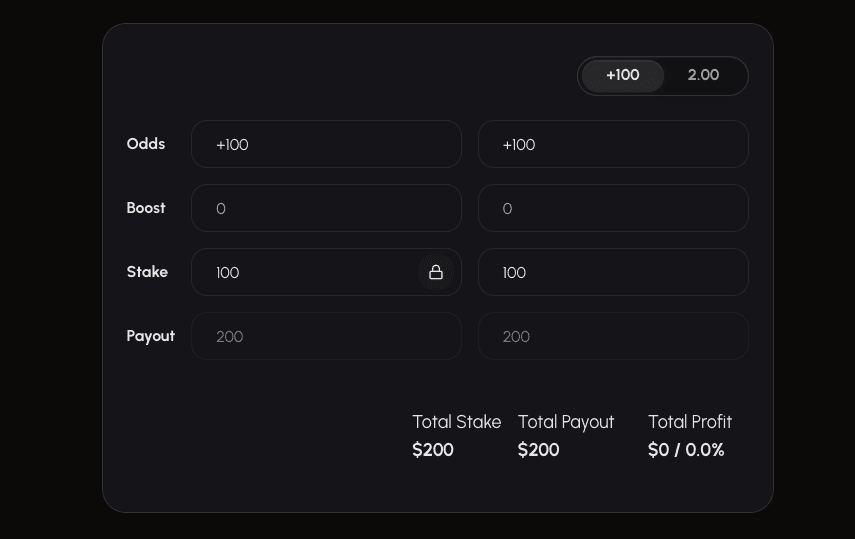
Arbs are small and close fast, so checking dozens of books by hand is not realistic. The free arbitrage calculator does the stake split for any two prices you bring it. It cannot find the prices for you.
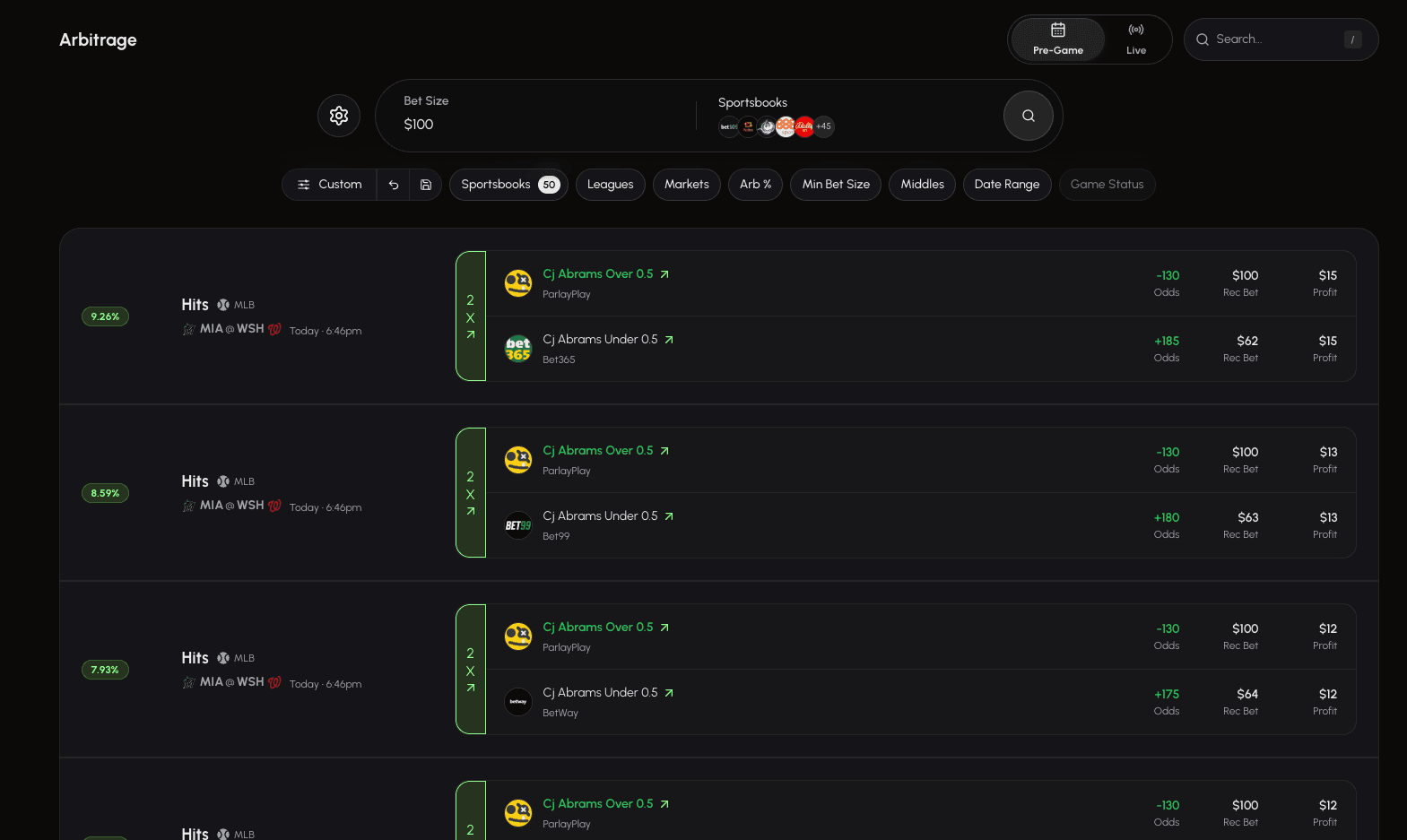
The Arbitrage Finder does the finding. It compares prices across 80+ sportsbooks in real time, runs the under-100-percent test on every market, and ranks what clears the bar with both stakes worked out. Filters narrow the board to the books you hold funded accounts at, a minimum arb percentage, and a minimum bet size, and saved filters can alert you when a match appears. The Arbitrage Finder and Live Arbitrage are part of SmartStake Premium.
The Arbitrage Finder tutorial walks through the board, and the roundup of the best arbitrage betting software compares the tools if you are still choosing one. Every tool still depends on execution: results are never guaranteed, and a margin is only real once both legs are accepted.
Frequently Asked Questions
What is arbitrage betting?
Arbitrage betting is placing bets on every outcome of the same market at different sportsbooks, with each stake sized so every outcome pays back the same amount. When the books disagree enough that their best prices add up to less than 100 percent implied probability, that shared payout is larger than the total you staked, so the margin is set when you place the bets rather than by who wins. It only holds if both bets are accepted at the listed prices, so it is not risk free.
How do you calculate arbitrage stakes?
Pick a stake for the first side, multiply it by that side's decimal odds to get the target payout, then divide the target payout by the other side's decimal odds. The result is the second stake. For example, $300 on −180 (decimal 1.5556) targets about $466.67, and $466.67 divided by 3.20 (+220) is $145.83. SmartStake's free arb calculator does this split for you from American or decimal odds.
Is arbitrage betting risk free?
No. The arithmetic of an arb is fixed, but the execution is not. A price can move between your two bets, a book can reject or cap your stake, a bet can be voided for a pricing error, and two books can settle the same market under different rules. Any of these can leave you holding one side at a loss. Treat the calculated margin as the best case that holds only when both legs fill at the prices you saw.
How much money do you need for arbitrage betting?
You need enough to fund both legs at once, spread across every book you plan to use, because each arb ties up money at two books until the game settles. The margin is a percentage of the total staked, so a 2 percent arb on $500 across both bets is about $10, not $10 per side. After each result the money sits at the winning book, so bettors who arb regularly also plan for moving funds between books.
Do sportsbooks limit arbitrage bettors?
Yes. Sportsbooks watch for the betting patterns arbitrage produces and can cut your maximum stakes, delay your bets for review, or restrict the account. That is a business decision the book is free to make, not a rule you broke. Most arbitrage bettors plan for accounts to have a limited life and weigh each bet against how long they want to keep a book open.
Get the next guide in your inbox
Practical betting guides, new tools, and product updates from the SmartStake team. Unsubscribe in one click, any time.
By providing your email, you are consenting to receive communications from SmartStake. Visit our Privacy Policy for more info
Similar articles
 SmartStake
Strategy
Live Arbitrage Betting: How In-Play Arbs Really Work
Live Arbitrage Betting: How In-Play Arbs Really Work
In-play arbitrage produces wider and more frequent gaps than pre-match, and kills them in seconds. This guide covers why live markets disagree, how little movement a live margin can absorb, what to do when only one leg fills, and the workflow that gets both bets down in time.
Jul 28, 2026 · 12 min read

FundamentalsArbitrage
What Is a Middle Bet? The Math Behind Middling Odds
A middle is two bets on opposite sides of the same market at different numbers, so both can win at once. This guide derives the hit rate a middle has to clear, shows why that number is the hold on your two prices and nothing else, and covers the half point middles that only ever push.
Aug 2, 2026 · 11 min read
SmartStakeFundamentals
What Is an Arbitrage Opportunity in Sports Betting?
What Is an Arbitrage Opportunity in Sports Betting?
A plain-English guide to arbitrage opportunities: the one-line test that defines them, a worked two-book example, why they appear, and how to find them without doing the math by hand.
Jul 27, 2026 · 9 min read