Bet Tennis at the US Open - Everything You Need to Know
Tennis is one of the best market making sports on prediction markets, if you know how to bet it.
- Author
- Alex Bow
- Published
- Aug 28, 2026
- Read
- 9 min

I never used to bet on tennis. For a long time it just felt like too much to learn, too many markets, too many rules that vary between books, and honestly a bit intimidating to throw money on a sport I didn't watch and didn't fully understand. But for about a year now I've been loving it. With the US Open coming up, I wanted to break it down for anyone who has been curious but hasn't pulled the trigger yet. There are a few things that burned me early on that are worth knowing upfront.
Moneyline: how tennis settles on a prediction market
Moneyline is simple on the surface, you're just picking who wins the match. But tennis has a quirk that can catch you off guard if you're coming from other sports. Retirements and walkovers are extremely common, especially in Grand Slam tournaments where the men play best of 5 sets and matches can last four or five hours. Retirement is when a player starts the match but physically can't finish it, usually due to injury. A walkover is when a player withdraws before the match even begins. This could be because they sustained an injury late in their previous match and pulled through that one but can't compete in the next, or because they played a brutal five setter and still haven't recovered physically by the time their next match comes around.
On traditional sportsbooks, both of these usually result in a push. You get your money back. On prediction markets, it works completely differently.
Kalshi and Polymarket essentially treat their tennis markets as "who advances," which means there is no push. If there is a retirement mid-match, the player who advances wins the market, full stop. If there is a walkover before the match starts, it depends on the tournament. For major tournaments like the US Open, the market resolves to a fair price based (usually) on the last traded price before the news broke, so you'll generally get back something close to what you paid. For lower level tournaments, walkovers resolve at 50/50. So if you bought a heavy favorite at 70 cents on a smaller ATP or WTA event and they withdraw before the match starts, you get back 50 cents per share and lose 20 cents. That risk is sometimes baked into how favorites are priced on these lower level markets, which is why you might notice them looking like better value against a traditional sportsbook line than they actually are once you factor in the walkover rule.
One thing that can catch you off guard on the fee side: if you bought a position as a taker, the fee you paid is not returned on a walkover resolution. Say the market is sitting at 50 cents and you buy at that price, but after Kalshi's taker fee your effective cost is 51.75 cents per share. If the match gets walked over and resolves at 50 cents, you get back exactly 50 cents, not 51.75. That 1.75 cents per share is gone. You broke even on the position itself but lost the fee on a bet that never happened.
Do not try to arb tennis moneylines between prediction markets and regular sportsbooks without fully thinking through the retirement implications. On most traditional sportsbooks you get a push on a retirement. On a prediction market you either win or lose depending on who it is. If your player retires you lose on the prediction market and push on the sportsbook. If the other player retires you win on the prediction market and push on the sportsbook. The outcomes are not equal and opposite the way a true arbitrage requires, so what looks like a clean arbitrage opportunity actually carries real one-sided risk.
The real opportunity: limit orders on individual player markets
Here's something I don't see talked about enough. On Kalshi and Polymarket, tennis matches don't just have one moneyline market. Each player has their own individual Yes and No market. More markets always means more opportunities.
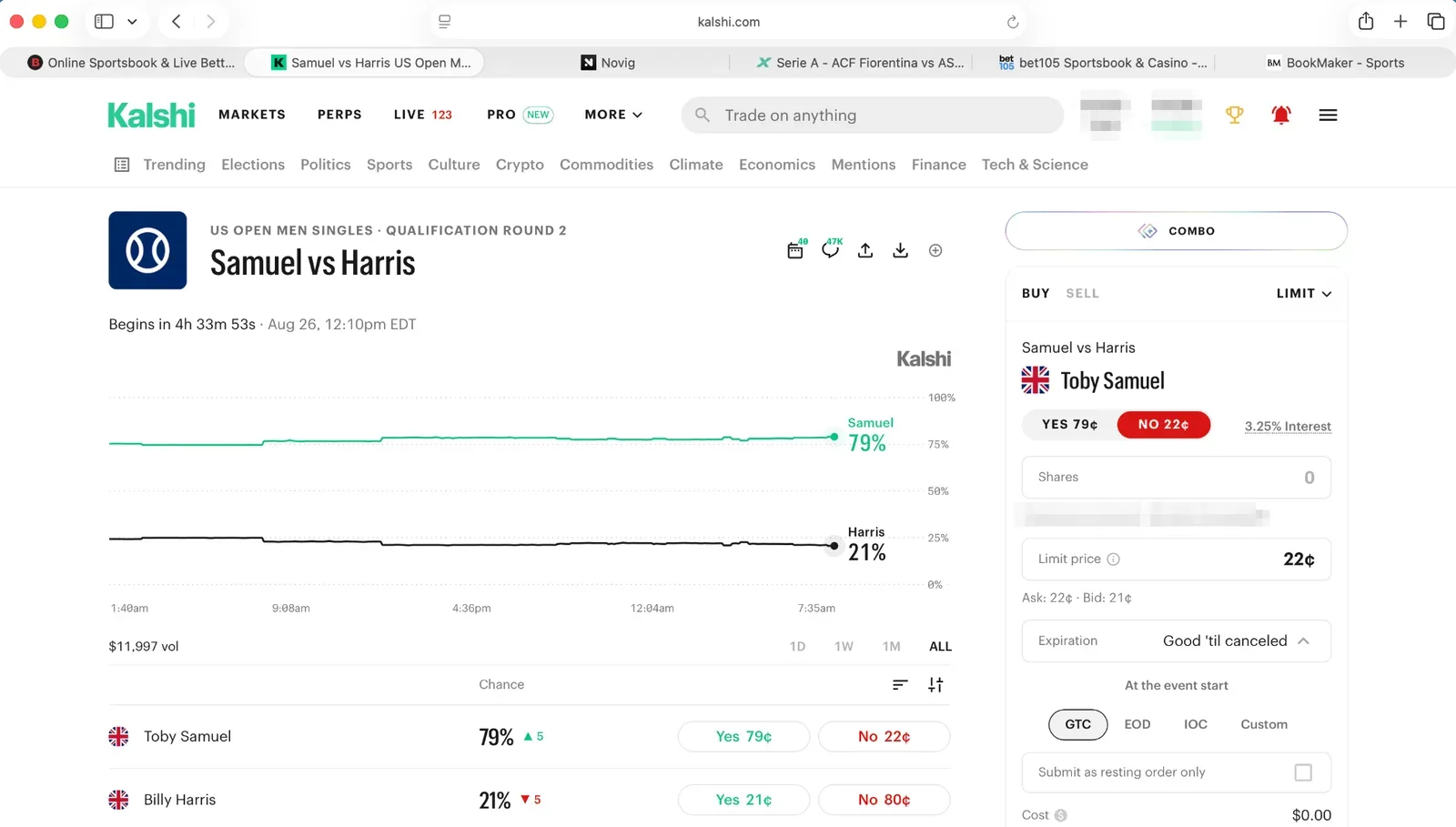
Take this US Open qualifying match as an example. This is a less liquid market than the main draw will be, but similar opportunities show up throughout the tournament, especially in the early rounds when there are 20 to 30 matches per day. You can see that Samuel is sitting at Yes 79c / No 22c, and Harris is at Yes 21c / No 80c. Those are 1 cent spreads on both markets, but they're offset by one cent from each other.
As a taker right now, you could buy Samuel at 79c or Harris at 21c. After fees those come out to roughly −404 and +351 respectively.
But here's where it gets interesting. The best available prices on the No side of each market are Samuel No at 22c and Harris No at 70c. You can place limit orders at both of the Yes sides: Samuel Yes at 78 and Harris Yes at 20c, which are the most competitive prices available and realistic candidates to actually get filled. Those two positions sum to 98 cents, meaning you've manually created a 2 cent spread across the two markets if you get filled. Given the original taker market was pricing this at −404/+351, getting filled at −361 or +393 is almost certainly +EV.
Take the ask, or rest a cent inside it
Samuel Yes
79¢
78¢
Harris Yes
21¢
20¢
Effective priceTake the askRest a limit
Samuel−404−361
Harris+351+393
Both sides, all in102.32¢98.58¢
Verdict on the resting pairLocks 1.42¢ per pair if both fill
Spread you manufactured, before fees2¢
What the maker fee takes back−0.58¢
Locked per pair, after fees1.42¢
Taking both asks instead would cost 102.32¢ per pair, so the same two contracts would lose 2.32¢. One Yes on each player covers both outcomes, so the pair always pays out $1 whoever advances.
Illustrative example prices, not live markets and not a recommendation. Fees use the published rate × p × (1 − p) schedule the SmartStake Kalshi and Polymarket calculators run on, and the locked figure assumes both limit orders actually fill. An order that only fills on one side leaves you holding a plain one sided position that can win or lose, so no two sided position here is truly risk free. Confirm the live fee schedule before sizing a trade.
As always with limit orders, keep an eye on the market. If the line moves against you while your order is sitting open, you could get filled at a price that no longer reflects fair value. Try to place these closer to match time where there is less volatility left in the market, and make sure you're monitoring them rather than just setting and forgetting.
This is something I do a lot when shopping around on prediction markets for tennis. Use the most liquid ones as a reference and then exploit the less liquid ones with wider spreads in this way. The individual player markets stack up in a way that a single two-sided market doesn't give you.
And on the arbitrage question: if you got filled at both 78c and 20c on the same platform, that is a completely different situation from arbing between a prediction market and a sportsbook. Same platform, same retirement rules on both positions, genuinely equal and opposite outcomes. That's a clean arb, and you'd be locking in a 2 cent spread per dollar on the pair. It only holds if both orders actually fill, though. A limit that fills on one side and not the other leaves you holding a plain one-sided position that can win or lose, so treat it as a two-sided position rather than a sure thing.
On fees, Kalshi has small maker fees while Polymarket has no maker fees, so the same limit order strategy on Polymarket would give you slightly better effective odds. That said, Kalshi tends to be more liquid, meaning faster fills in many cases. There is a tradeoff and it's worth testing both to see where you get filled more consistently. For the full cost comparison, see Polymarket vs Kalshi and Kalshi vs sportsbook.
Game spreads vs set spreads in tennis
This one confused me for a while before I figured out how tennis scoring actually worked, so let me break it down quickly.
A game is the basic scoring unit in tennis, the 15-love, 30-15, deuce, advantage back and forth. That's one game. A set is a collection of games. To win a set you have to reach 6 games, win by 2. If it reaches 6-6 and nobody has led by 2 with 6 wins, they play a tiebreaker, first to 7 points win by 2, or 10 points in Grand Slam deciding sets, and the winner takes the set 7-6. A match is a collection of sets. At the US Open, women play best of 3 sets and men play best of 5.
Set spreads are usually −1.5 or +1.5, and for men's matches you'll also see −2.5 and +2.5. These work like any other spread bet.
Game spreads are where things get interesting, and genuinely frustrating if you're watching the match. You can not only lose the game spread while your player wins the match, you can literally win fewer total games than your opponent and still win the match. A women's match could end 7-6, 1-6, 7-6, where the winner won 15 games and the loser won 18. In longer men's matches this could become even more pronounced. Players will often deliberately give up a set they can't win to save energy and simultaneously tire out their opponent, which can completely blow up a game spread even if your player wins comfortably on the moneyline and set spread.
For pure +EV betting purposes, there is absolutely value on game spreads and you should treat them like any other market. But if you're also trying to enjoy watching the match, game spreads can be genuinely rage-inducing. Just something to be aware of going in.
The schedule: why tennis start times are placeholders
One thing that trips up a lot of people trying to market make on tennis is the schedule. Grand Slam tournaments assign start times to matches at the beginning of the day, but those times are essentially placeholders. Everything is played sequentially on each court, so if the match before yours runs long, your match starts late. A men's match scheduled for noon could take 90 minutes or five hours. The "3pm" listed for the next match is a guess at best.
This matters a lot for limit orders on prediction markets. If you have limit orders set to expire at the listed start time, they will likely expire long before the match actually begins, and you'll miss the opportunity entirely. Prediction markets will update the start time as information changes, but your order expiration doesn't automatically adjust with it.
The flip side is worth knowing too. A lot of other people's orders do expire at the original listed start time, and when that happens the market often gets wider and there are fewer orders sitting in the queue ahead of you. That can be one of the better times to get your limit orders in at a better price and a better position. So the chaos of the schedule actually creates a window if you're paying attention.
Watch the coin toss for game spreads
This one is specifically for anyone placing limit orders on game spreads who plans to manually cancel before the match starts. Make sure you cancel before the coin toss, not just before the first point.
The coin toss determines who serves first, and that is a genuinely significant variable for game spreads. A quick note on terms: a service game for player A is a game where player A is serving. A break of serve is when player B wins a game that player A was serving in, which in tennis is considered a significant advantage since players are expected to hold their own service games.
Here's a simple example. Say a player wins every service game he plays and earns exactly one break of his opponent's serve early in the set. If he served first, he wins the set 6-3. If his opponent served first, he wins the same set 6-4. Same outcome, one game difference just from who served first. That one game matters a lot when you're talking about game spread bets.
The game spread market moves right after the coin toss for exactly this reason. If you have a limit order sitting open and the toss goes the wrong way, you might get filled at a price that no longer reflects fair value. Just cancel before the toss if you're not ready to adjust.
The Closing Line
Tennis is one of the better sports to bet on prediction markets right now. The markets are liquid enough on the bigger tournaments to get meaningful positions in, but not so deep that you can't find value. You'll often see 2-3 cent spreads rather than the 1 cent you get on the biggest mainlines, which gives you real room to get filled at better prices as a market maker. Once you understand how the scoring works, what the retirement rules mean, and how to use the individual player markets to your advantage, the complexity mostly goes away. Two weeks of wall-to-wall matches with a wide range of liquidity levels means there are opportunities throughout the day, at every skill level of bettor.
Compare live prediction market prices against the books on the SmartStake Odds Screen
Alex Bow
Alex Bow trades tennis and baseball markets on Kalshi and Polymarket and writes about prediction market structure for SmartStake.
Every issue of The Closing Line →Subscribe / Weekly
Get the next issue in your inbox, before the line moves.
Free, unsubscribe anytime. By subscribing you agree to receive emails from SmartStake. See our Privacy Policy.