How Prediction Markets Changed the Way I Bet Futures
Why prediction markets like Kalshi and Polymarket changed futures betting for me: visible fair value, two-sided No bets, and positions you can exit anytime.
- Author
- Alex Bow
- Published
- Sep 15, 2026
- Read
- 7 min

I've always had a complicated relationship with futures betting. Picking a champion before the season starts feels rewarding in a way a random Wednesday night game does not, and the value is theoretically there if you know where to look. But for years I mostly stayed away, and the more I understood about how these markets actually work, the more that made sense. Prediction markets have genuinely changed that for me, and I want to explain why.
The problem with one-way markets
Most futures markets at traditional sportsbooks are what we call one-way markets. You can bet a team to win the championship, but you can't bet them not to. This sounds like a minor thing but it has a pretty significant consequence. You have no idea what the book thinks fair value actually is.
In a standard two-way market, spotting bad pricing is easy. If a moneyline is at -130/-130, you can immediately see the spread is wider than it should be, and any experienced bettor is going to shop around and find a better number somewhere else. The book has to stay somewhat competitive because you can see both sides.
With futures, that transparency disappears. Take the current DraftKings Super Bowl market. I went through every team, calculated their implied win probability from the odds, and added them all up. Keep in mind, these win percentages are not with the vig removed, these are simply raw implied probabilities from an odds converter.
| Team | Odds | Win % |
|---|---|---|
| LA Rams | +550 | 15.4% |
| BUF Bills | +1,000 | 9.1% |
| BAL Ravens | +1,000 | 9.1% |
| SEA Seahawks | +1,100 | 8.3% |
| PHI Eagles | +1,600 | 5.9% |
| NE Patriots | +1,600 | 5.9% |
| KC Chiefs | +1,600 | 5.9% |
| LA Chargers | +1,700 | 5.6% |
| HOU Texans | +1,800 | 5.3% |
| GB Packers | +1,800 | 5.3% |
| SF 49ers | +1,900 | 5.0% |
| DET Lions | +1,900 | 5.0% |
| DEN Broncos | +2,000 | 4.8% |
| CIN Bengals | +2,000 | 4.8% |
| CHI Bears | +2,400 | 4.0% |
| DAL Cowboys | +2,500 | 3.8% |
| JAX Jaguars | +3,000 | 3.2% |
| All teams above +3000 (15 teams) | 16.3% |
The total implied probability across all 32 teams comes out to 122.7%. Subtract 100% and you get the hold percentage: 22.7%. That's the book's expected profit on every dollar wagered in this market over the long run. To put that in perspective, a standard two-way moneyline at -110/-110 implies 52.4% for each side. Add those together and you get 104.8%, which is only a 4.8% hold. That's what a competitive market looks like. 22.7% is not competitive, it's a tax on people who don't know it's there.
And that's exactly the point. In a two-way market, if a book moves a team from +800 to +750, you can immediately check the other side. If the no side moved from -1000 to -950 in tandem, that makes sense, new information came in, the market adjusted. But if only one side moved and the other didn't, that's the book quietly widening their margin, and you can spot it immediately because both sides are right there in front of you. In a one-way market, that same move is completely invisible. There's no other side to check. The book can shave odds across the board, inflate their hold percentage, and the futures board looks completely normal. You'd have no idea without building out a table like the one above, and most bettors aren't doing that.
There's also something bigger here that doesn't get talked about enough. The ability to bet "No" on a futures market, meaning a team does NOT win a championship, does NOT win a tournament, a player does NOT win an award, is essentially unheard of on traditional sportsbooks. There were a handful of books that allowed some two-way futures markets, but nothing at the scale or consistency we have now. This is genuinely uncharted territory for bettors, and it opens up a lot of doors.
Think about it this way, the public has always had a slight lean toward overs, and as a result there tends to be more value on unders. I've found the same pattern holds on prediction markets. The "No" side consistently offers better value than the "Yes" side because recreational bettors naturally gravitate toward rooting for things to happen. On top of that, most takers on prediction markets are casual bettors placing "Yes" orders, which means when you're on the "No" side, you're much more likely to get filled quickly. More liquidity, better prices, and a market segment that was basically closed off before. That's a real edge.
What prediction markets actually fix
On prediction markets like Kalshi and Polymarket, every single market has to be two-sided. If you buy the Bills to win the Super Bowl, you're filling the order of someone who bet the Bills to not win. The prices reflect actual peer-to-peer trading, and you can see both sides of every outcome at any time.
This changes everything about how you evaluate value. If Kalshi has the Bills trading at 10 cents (10%), that means the market is also implying a 90% chance they don't win. Run that through an odds converter and you get roughly +900 on the yes side. If DraftKings is offering +800 on the same outcome, you now know exactly how much worse that price is. You don't need to guess, you don't need to build a spreadsheet, the fair value is just sitting there. You can also use prediction markets as a +EV indicator on rec books. If the Bills to win the Super Bowl is +1000 on DraftKings, and ‘No’ on Kalshi is -900, that is a +EV bet on DraftKings. It works both ways.
The flexibility argument
Even setting aside pricing, there's another reason I avoided futures for a long time. Your money is stuck. A 5% EV bet that resolves tonight is a completely different animal than a 5% EV futures bet that doesn't settle for eight months. If you want to get technical about it, you can calculate the implied return you're giving up by tying up capital for that long. But even without the math, intuitively you understand that holding a cash position for most of a year costs you something.
Traditional sportsbooks know this and they use it against you. The minute you place a future on DraftKings, your $500 wager is immediately worth maybe $450 in cash out value. That is the new ‘value’ of your wager, 90 cents on the dollar, when there is no convenient or fair way to exit that position. And unless odds move dramatically in your favor, you're unlikely to ever see that number rise above what you put in, especially months before the event resolves. You're essentially giving the book an interest-free loan for the duration, and they've structured the cashout terms to make sure getting out early punishes you.
Prediction markets are different. Your position is liquid, tradeable, and priced fairly at any moment.
The position below is one real trade of mine, captured in August 2026. It is an illustrative example of managing a tradeable position, not a typical result or a prediction, and results vary.
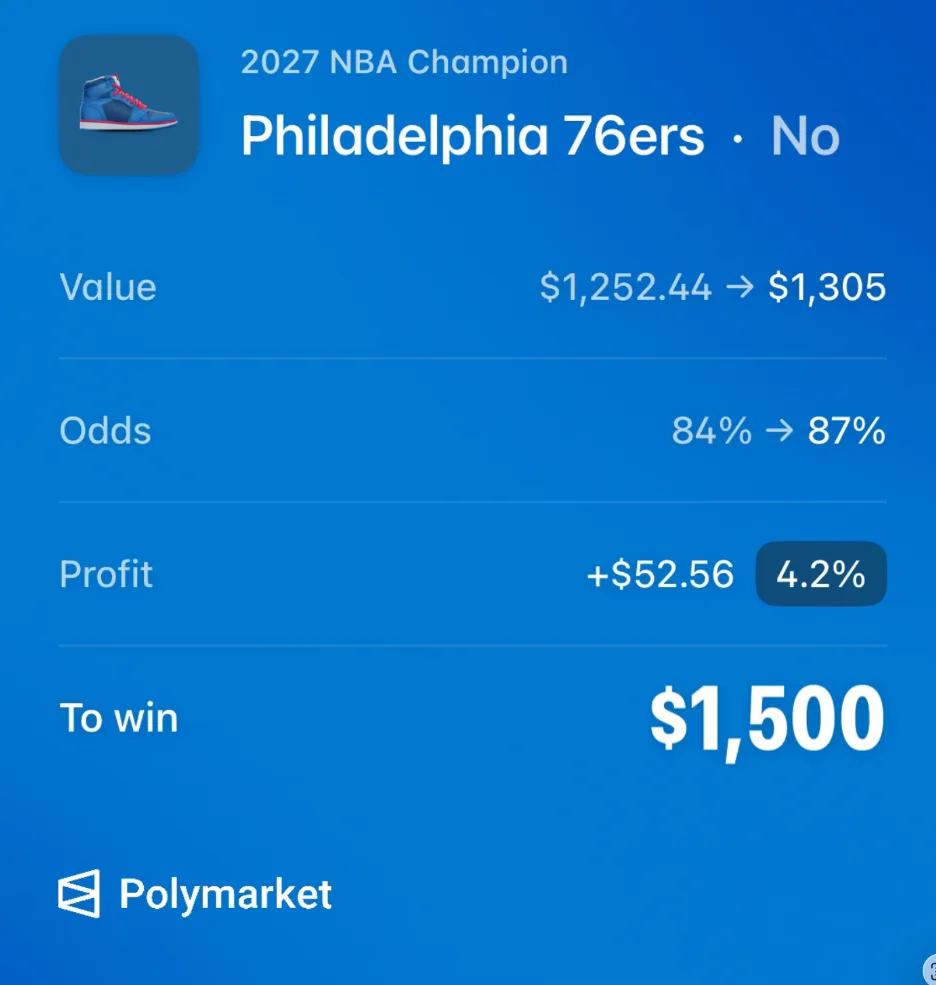
This was a position I opened the day LeBron signed with the 76ers. The market was moving around a ton, and I thought recreational bettors were piling onto Philly as a reaction to the news. I bought the "No" side at 84 cents, and the position has since risen to around 87 cents, sitting at about a 4.2% profit on paper.
I want to be clear, I'm not showing this as a guaranteed winner or a prediction about how Philly's season plays out. The point is what I can do with this position at any moment. If my bankroll takes a hit somewhere else and I need cash, I can sell instantly at a fair market price and lock in that profit. If this were a DraftKings wager, I'd either have to wait until June for it to resolve or cash out at a loss, even on a position that's clearly working. With Polymarket, neither of those is true. I can hold as long as I want, size up or down depending on how things develop, or exit completely whenever I feel like it. That flexibility simply didn't exist before.
Futures as a trading tool
This is the mindset shift that prediction markets actually enable. Futures are no longer just a bet you place and forget. They're positions you can actively manage.
The other thing working in your favor with futures that I think gets underappreciated is volatility, or the lack of it. Game markets are wild, a single play can swing them 20%. Futures markets move slowly. Look at the NBA champion market this past year. Oklahoma City was sitting at 30% of the market all last summer and through most of the season, and barely moved 10% over twelve months (That star on the chart is around the time when the NBA finals started). If you're confident in a position and the market disagrees, you have months of time to be right before anything resolves, and the day-to-day swings are small enough that you can size up more than you might on a game market.
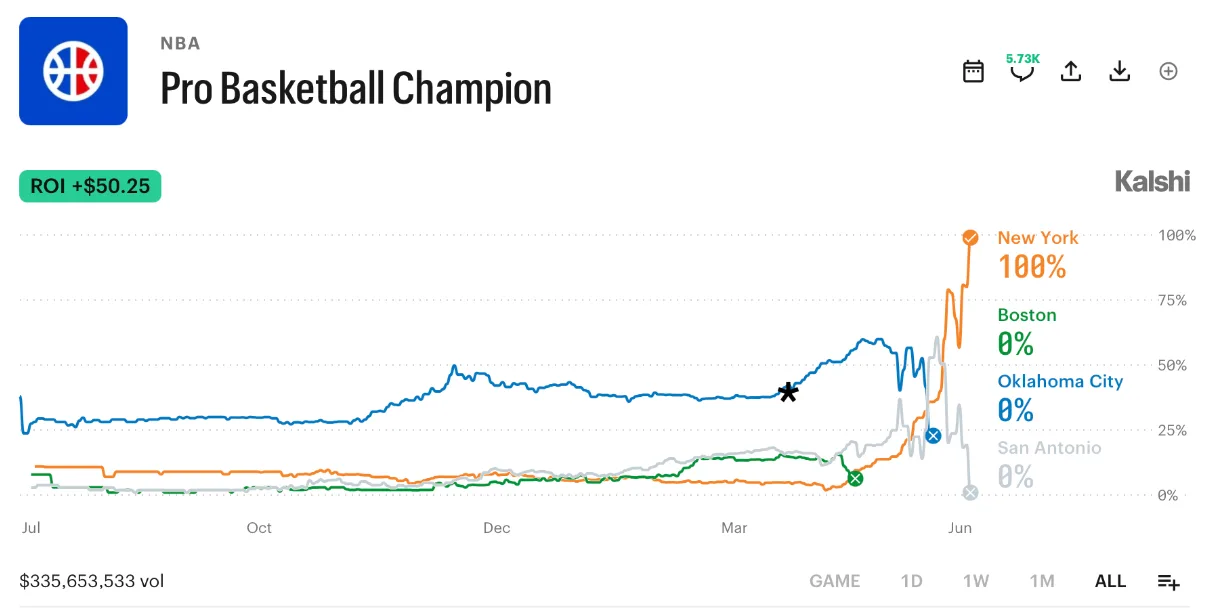
That chart tells the whole story. Gradual, stable movement, with real volatility only showing up at the very end when things actually got decided. That predictability is valuable. It means you can put down a larger position without the same anxiety you'd have on a game bet, because even if the market moves against you short-term, you have time to react and adjust.
Some prediction markets have also started offering interest on open positions, which addresses the time value problem more directly. They make money through fees regardless of who wins, so incentivizing people to hold longer positions just means more trading volume for them. It's a good deal for both sides. You get compensated for tying up capital, they get more activity on the platform.
I don't want this to come off as though there are just tons of +EV opportunities sitting on prediction markets at all times. That's not what I'm saying. What I'm saying is that the flexibility these platforms offer opens the door to more opportunities than existed before. Prediction markets are still relatively new, and on more niche futures, the liquidity just isn't there yet. Wide spreads, no taker value, and even if you can post a genuinely great price, it's unlikely you'll get filled on a low-volume market. The major championship markets are liquid enough that this isn't usually a problem, but on anything more obscure, keep those expectations in check.
The Closing Line
Futures betting on traditional sportsbooks was always a bit of a trap. High hold percentages hidden behind one-way markets, bad cashout terms, and your money locked up for months with no real exit. Most of those problems are solved on prediction markets. You can see fair value, you can exit when you want, you can bet "No" on outcomes that were completely inaccessible before, and you can actually manage a position rather than just hoping it hits.
I'm not saying every futures bet you make on a prediction market is going to print. Markets are still efficient most of the time, and finding real edge is never easy. But the structural disadvantages that made futures an afterthought for serious bettors are mostly gone now. That changes the math in a real way, and it's changed how I think about this part of my betting entirely.
Alex Bow
Alex Bow trades tennis and baseball markets on Kalshi and Polymarket and writes about prediction market structure for SmartStake.
Every issue of The Closing Line →Subscribe / Weekly
Get the next issue in your inbox, before the line moves.
Free, unsubscribe anytime. By subscribing you agree to receive emails from SmartStake. See our Privacy Policy.