Finding Fair Value on Prediction Markets
Devigging alone misleads on prediction markets and exchanges. How liquidity imbalances, fees, and spread width move fair value, and which SmartStake tool to trust.
- Author
- Alex Bow
- Published
- Sep 23, 2026
- Read
- 8 min

If you're a SmartStake user, you're probably already familiar with the positive EV tool. You pick a set of sharp books to devig to, the tool calculates a fair value, and anything at a price better than that fair value on another book shows up as a positive EV opportunity. If you're reading this, you almost certainly know how this works already, so I'm going to skip the basics and get into something I think deserves more attention. How do you actually find fair value on prediction markets and exchanges, and why you shouldn't always devig them the same way you would a traditional sportsbook.
Where simple devigging works well
The EV tool works cleanest when you're devigging from traditional sharp sportsbooks. Pinnacle, Circa, FanDuel, and similar books set two-sided markets where both sides are available and the spread is relatively predictable. If a market is sitting at +100/-120, devigging it essentially finds the midpoint in implied probability. +100 implies 50%, -120 implies about 54.5%, so the fair value lands around 52.25%, which is roughly -109. If your sharp books devig to +109 on the over and you can find the over at +115 somewhere else, that's a clear +EV bet. Same goes for the under, if it devigs to -109 and you can get it at -102, that's also +EV. Clean, simple, and the math holds up well.
This is the foundation of how the EV tool is designed to be used, and for traditional two-sided markets with consistent spreads and comparable liquidity on both sides, it does the job well.
When liquidity changes the picture
Here's where things get more nuanced. Prediction markets and exchanges don't always behave like traditional sportsbooks, and simply devigging their lines the same way can give you an incomplete picture.
Imagine a prediction market where a total is sitting at -105/-105, but on the over there's only $1,000 in liquidity available, and on the under there's $500,000. If you devigged that, you'd get +100 as fair value. But would you really treat both sides the same here? I wouldn't. The massive liquidity imbalance tells you something. Someone is very confident in the over, confident enough to offer half a million dollars to the market. If I had only that one data point and had to pick a side at +100, I'm taking the over, and I'd argue the actual fair value is somewhere closer to -102 or -103 on the over, not +100. That might sound like a small difference, but margins on prediction markets are thin. A lot of this is high volume, low EV percentage betting, so a 2 or 3 cent shift in fair value can be the difference between a bet being +EV or not. Simple devigging doesn't capture any of that, it just sees the odds.
There is no set formula for adjusting fair value based on liquidity imbalance, and that's kind of the point. You need multiple data points to build a real picture. Multiple prediction markets with different liquidity pools, plus traditional sharp books devigged the standard way, all together paint a more complete picture than any single calculation.
The illiquid market problem
This is where finding fair value on exchanges gets the most difficult. Take a look at this market.
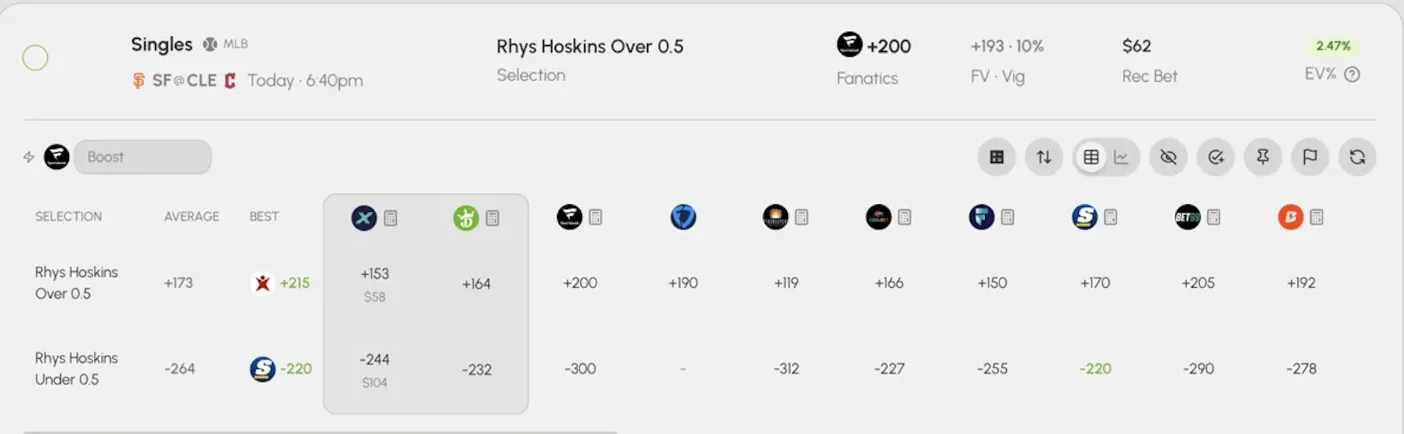
Rhys Hoskins Over 0.5 Singles. ProphetX, one of the sharpest exchanges for MLB props, is sitting at +153/-244. That's a 97 cent spread. DraftKings is similarly wide. Using optimal weighting from our MLB player props study, the EV tool calculates a fair value of around +193 on this market, and flags Fanatics at +200 as a positive EV bet. But can we actually trust that number?
When the spread is this wide, the market is essentially telling you it doesn't have a strong opinion on where to price this yet. No one is willing to offer anything competitive on either side. That +193 fair value is built on shaky ground. Depending on your devig method and settings, the number could reasonably land anywhere from +175 to +215. The actual fair value could be +215 and the Fanatics line has no value. Or it could be +175 and Fanatics at +200 genuinely is the edge it appears to be. You just don't know.
What makes this example even more interesting is FanDuel's one-way line at +190. FanDuel's one-way prop lines are notoriously stingy, they price these markets to extract maximum hold knowing most bettors won't shop around. So if FanDuel is offering +190 on a one-way market, their internal fair value is almost certainly somewhere around +220 to +230. That's a data point that actually pushes back against the EV tool's +193 calculation. If FanDuel thinks fair value is +225 and they're offering +190, Fanatics at +200 might not be the edge it looks like on paper.
This is the kind of context that no calculator can bring for you. I do set a maximum market width in the EV tool, around 10%, which filters out some of the worst cases. But for illiquid markets you want to see tight spreads with serious liquidity on both sides before you put real confidence in the fair value number.
How fees affect your fair value calculation
The other thing worth understanding is how prediction market fees interact with the lines you see on SmartStake.
On the arb tool and EV tool, fees are already baked into the displayed odds, and that's actually the right way to show them. If you're going to be a taker and place a bet right now, that is the price you're actually getting, and the tools showing you post-fee odds means you won't be surprised by the real payout. That's not a flaw, it's doing exactly what it should.
The nuance comes in when you're using those lines to think about fair value, or when you're considering placing a limit order instead of taking.
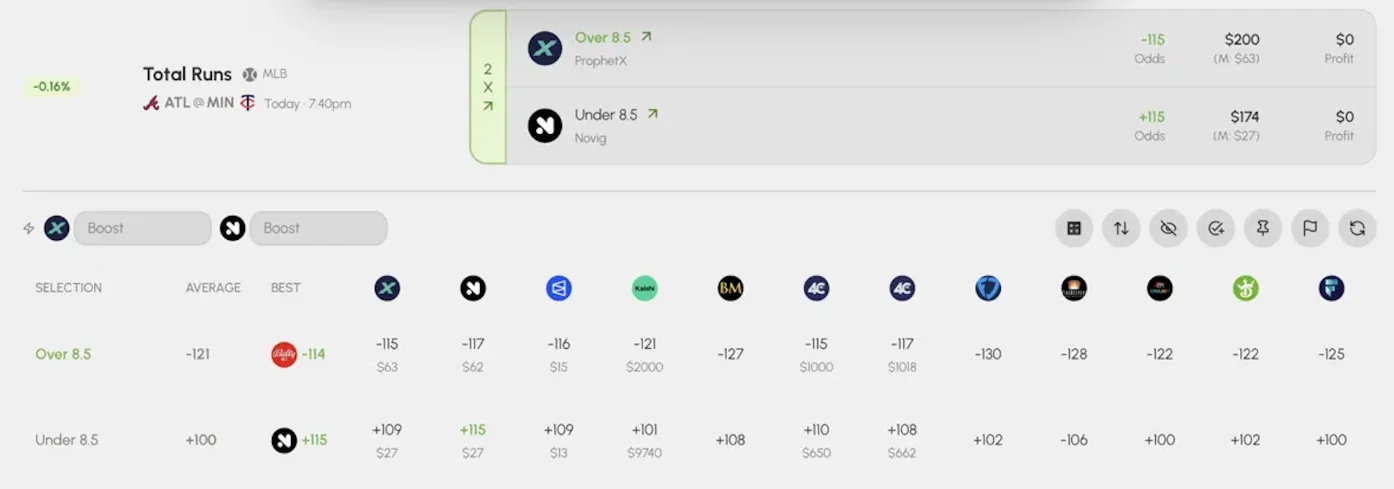
Look at this market. Kalshi is showing -121 on the over and +101 on the under after fees. Without fees, this is a 53/48 cent market, which translates to roughly -112/+108. The person who placed the limit order offering the over at 53 cents is trying to get matched at +112, not +121. The -121 is purely what you pay as a taker after Kalshi's fee is applied. When you take at -121, they receive +112. The gap between those two numbers is entirely the fee.
So if you can find the under at +115 somewhere, like Novig in that screenshot, the arb tool might not flag it as a crossed market because it's comparing +115 to Kalshi's displayed -121. You can actually see this in the screenshot itself, the arb tool is showing a slightly negative arb percentage. But it actually is crossed, because the person on the other side of that Kalshi position is trying to get +112. The same logic applies to Polymarket and ProphetX after their fees are factored in as well. The fee obscures a real opportunity that the Smart Money tool will surface clearly.
The Smart Money tool shows the actual odds the person with the limit order is offering, with the fee removed, so you're seeing what they're actually trying to get matched at. That gives you a much clearer picture of where limit orders are really sitting relative to prices elsewhere, and lets you spot crossed markets that the fee-adjusted display would hide.
One more thing worth thinking about on fees. Kalshi and Polymarket specifically have high taker fees, and paying the full taker fee makes your odds significantly worse than they look at first glance. If you take a 53 cent bet on Kalshi as a taker, you're getting -121 after fees. But if you place a limit order at 52 cents instead, just one cent lower, you enter the liquidity pool at the best available price for takers on the other side, pay little to no maker fee, and if you get filled you're getting -108. That's a meaningful difference. The Polymarket odds converter shows the same after fee math for Polymarket's sports rate.
The tradeoff is real though. A limit order means you might not get filled, and you're exposed to the market moving while your order sits. For example, if the market shifts to 50/50 while your 52 cent limit order is still active and you get filled at that point, you're no longer sitting on a +EV bet, you'd be filled at a price that now represents fair value or worse depending on how far the market moved. With any limit order, make sure you’re monitoring the market consistently, don’t forget to cancel if you don’t get filled before the game begins, and generally try to place them closer to game time where there’s less volatility left in the market.
A note on highly liquid mainline markets
One thing worth mentioning before getting into what I actually do. For major mainline markets on Kalshi, like NFL and NBA game lines, the 1 cent spread is essentially locked in across the board. The fees are symmetric on both sides, so a 53/48 cent market always looks like -121/+101 on Kalshi, a 51/50 cent market always looks like -112/-108, and so on. Those odds never drift, because the spread can't get tighter than 1 cent and the fee structure is consistent. In those cases, devigging the traditional way is more viable, because the symmetric fees mean finding the midpoint still gives you a reasonable fair value. You'd still want to look at the liquidity on each side, but the calculation itself is more reliable.
Polymarket is a bit different, it offers half cent spreads on some markets, but again the fees are symmetric on both sides for takers regardless, so if liquidity is balanced you can feel more confident in a normal devig there too.
And if you add Kalshi and Polymarket to your sharp book references across the EV tool, arb tool, and Smart Money tool, you'll start to notice that on these highly liquid tight-spread mainline markets, all three tools are surfacing very similar bets. At that point it becomes more of a preference, since each one gives you slightly different information and a different lens on the same opportunity.
What I actually do
The arb tool is my most used tool on the platform even though I rarely do pure arbitrage. I use it primarily to hunt crossed markets, because liquid prediction markets are the sharpest reference points available right now for most mainline markets. The Smart Money tool runs a close second, both for checking fee-removed lines and for getting a read on where the large positions are sitting near fair value. A big limit order leaning one way tells me more than a devigged midpoint in a lot of cases.
For player props specifically, I still lean on the EV tool with traditional sharp sportsbooks as the devig source more than exchanges. Props are less liquid on exchanges, the spreads are often wide, and a tight DraftKings or FanDuel line gives me a more reliable fair value reference than a ProphetX market with a 97 cent spread. As game time gets closer and the exchange prop markets tighten up, I'll shift more toward the arb and Smart Money tools as those lines become more useful.
There is a place for all of these tools. The key is understanding what each one is actually measuring and what context it can't see for you.
The Closing Line
Finding fair value on prediction markets is genuinely more complex than running a standard devig calculation. The liquidity imbalances matter, the fees matter, and the width of the spread matters in a way that doesn't apply the same way to traditional sportsbooks. The tools on SmartStake are built to give you the right information for the most common use case, which is placing a bet right now at current odds. Your job is to layer in the context on top of that.
The market is getting faster, exchanges are becoming the dominant pricing source, and the edge is getting harder to find. The bettors who stay ahead are the ones thinking through what the data actually means, not just what the tool output says.
Alex Bow
Alex Bow trades tennis and baseball markets on Kalshi and Polymarket and writes about prediction market structure for SmartStake.
Every issue of The Closing Line →Subscribe / Weekly
Get the next issue in your inbox, before the line moves.
Free, unsubscribe anytime. By subscribing you agree to receive emails from SmartStake. See our Privacy Policy.